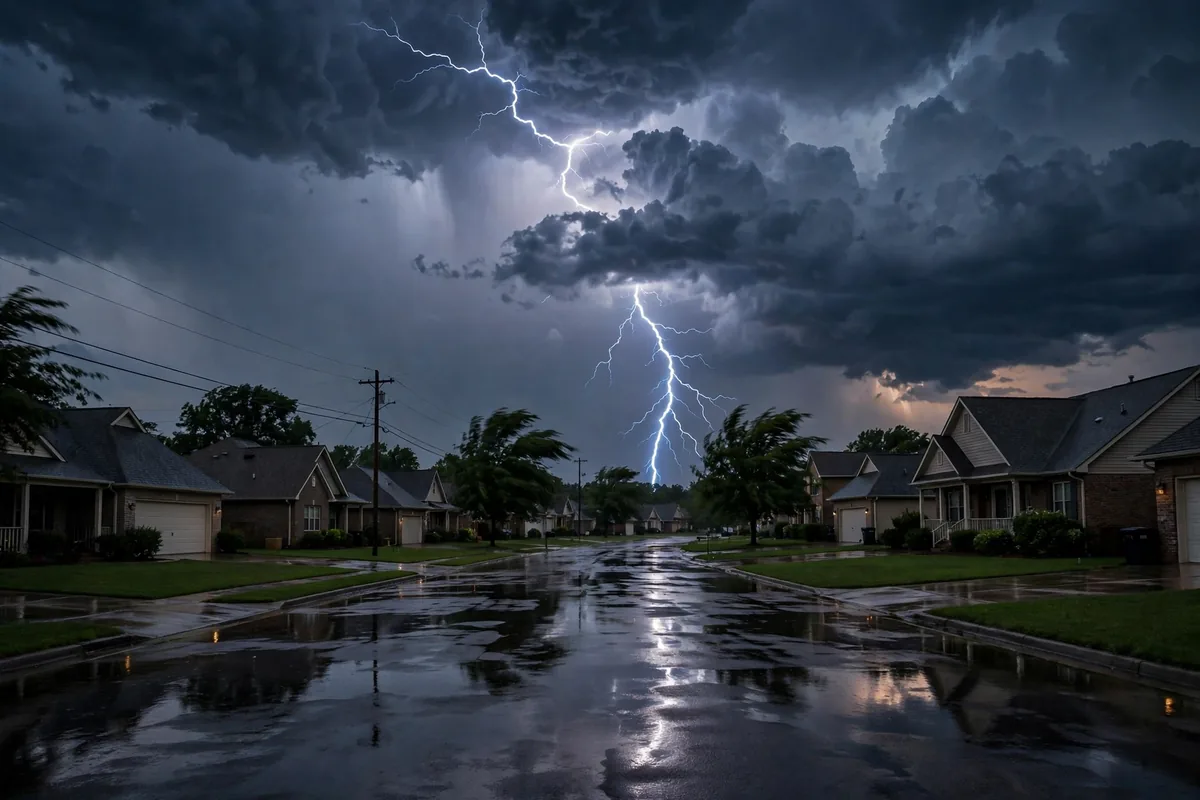
Robertson County sits in a corridor where spring lines and summer pop-up storms stack lightning over Springfield week after week. Every strike nearby and every utility switching event sends a voltage spike looking for a path. This article explains where that path usually ends (your appliance boards) and how layered protection changes the outcome.
Surges Are Mostly Not Direct Strikes
Direct lightning strikes are rare. The common damage comes from nearby strikes and grid switching: smaller surges, thousands of volts for microseconds, arriving several times a season. They rarely kill equipment outright. They wound control boards in HVAC systems, refrigerators, washers and TVs, which then fail weeks later for 'no reason'.
Why Plug Strips Fall Short
A power strip protects only what plugs into it, its clamping components wear out silently, and it does nothing for hardwired equipment: your HVAC, well pump, water heater controls and garage door opener are all exposed. Strips are the last layer of defense, not the system.
Layer 1: The Meter and Panel
A meter socket arrester, offered in Springfield through the Springfield Electric Department, blunts the biggest spikes at the service entrance. A panel-mounted surge protective device then clamps what remains before it spreads across your circuits. Together they protect every circuit in the house. Our whole-home surge protection page covers installation.
Layer 2: Point-of-Use Protection
Quality surge strips still earn their place at computers, entertainment centers and home offices, as the final layer behind panel protection. Buy by clamping rating and replacement indicators, and retire strips whose protection light has gone dark.
The Grounding Nobody Mentions
Every surge device works by dumping energy to ground. A corroded or missing ground electrode system quietly disarms the whole strategy. Any surge installation should start with a grounding inspection, ours does.
Related Reading
- Why Does My Breaker Keep Tripping?
- Flickering Lights: Causes From Minor to Serious
- Burning Smell From an Outlet: What To Do Right Now
Need hands-on help in Springfield, TN? Call (615) 716-3086.